

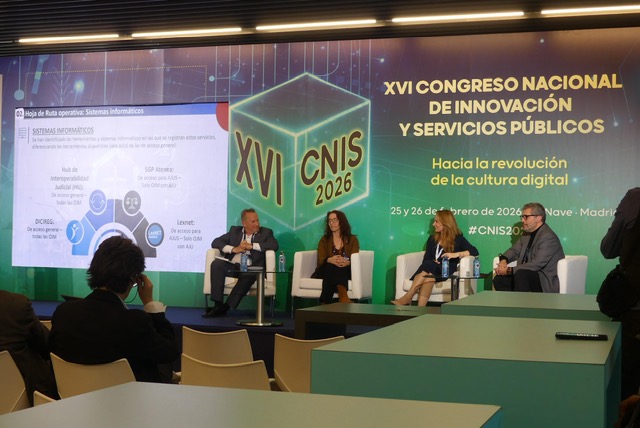
As part of the first day of XVI CNIS Congress, Auditorium II of La Nave became the setting for an in-depth analysis of the transformation of the local justice model. Under the title «"Municipal Judicial Offices: Present or Future of Public Administration?"», A panel of experts discussed the evolution of the old Justice of the Peace Courts towards a technological, efficient model fully integrated into the architecture of the 21st century Administration.
A paradigm shift: From physical proximity to digital efficiency
To address such a crucial topic, KAwaru brought together four leading experts who combine strategic vision, management experience, and technical knowledge:
-
Andreu Francisco Roger: (General Manager of Localret). With a consolidated track record in the digital transformation of the public sector and deep experience in municipal management, Andreu acted as moderator, linking the political challenges with the operational solutions.
-
Iolanda Aguilar Juncosa: (Secretary of the Government of the High Court of Justice of Catalonia). A key figure in the judicial structure, whose vision is fundamental to understanding how the administration of justice unfolds across the territory and the importance of legal certainty in new digital environments.
-
Fabiola Soliño Díaz: (Director of the Judicial Office at the Ministry of Justice). An expert in the architecture of new office models, Fabiola provided the state perspective on how the Organizational Efficiency Bills are redefining the role of municipalities.
-
Eduardo Abenójar Bonilla: (Councilor for Innovation at Salou City Council). He contributed a perspective from the municipal "trenches." His experience in implementing complex administrative processes is vital for understanding how to integrate judicial powers into the daily operations of a large city council.
The debate began with a clear premise: the need to move beyond the traditional model to respond to the demands of a citizenry that expects immediacy and digitalization. The speakers agreed that the Municipal Judicial Offices (OJM) They should not be seen merely as an administrative evolution, but as a fundamental pillar of the "digital culture revolution" championed by the motto of this edition of the CNIS.
Key points of the debate
During the 45-minute session, the challenges and opportunities presented by these offices were discussed in detail:
-
Transformation of the Justice of the Peace Courts: The discussion focused on how the transition to Municipal Justice Offices (OJM) provides municipalities with more agile procedural tools, reducing bureaucracy and bringing the administration of justice closer to the citizen without requiring them to travel to the judicial district headquarters.
-
Interoperability and Data: It was emphasized that the "future" mentioned in the title is already the "present" thanks to the implementation of management systems that allow the exchange of data in real time between local administrations and the Ministry of Justice.
-
The human factor in technology: Fabiola Soliño and the other speakers stressed that, although technology is the driving force, the success of these offices lies in public talent and the ability of civil servants to adapt to a proactive service environment.
«"Municipal Judicial Offices are not just a processing window; they are the point of contact where justice is humanized through technology."», she stood out during one of the most applauded speeches.
Present or Future?
The panel's conclusion was unanimous: Municipal Judicial Offices represent a present necessary which is laying the foundations of future of local government. The integration of services, video assistance, and electronic document management are already realities in many municipalities that act as a spearhead for the rest of the national territory.
Thank you all so much for contributing your vision to this project with a huge impact on the digital transformation of the justices of the peace.